RUBRIC WISE
New! Digital resource
You don't need to remember everything. You need a structure.
The Rubric Wise Acute Case Taking Prompt Cards were built for the moment when a case is moving fast and you need to stay calm and focused, whether you're a student in your first internship case, or a home prescriber at midnight with a sick child.
Instant access · PDF
A structured 9-box framework for 10 common acute conditions, so you know exactly what information to gather before you open the repertory. For students in training and home prescribers. 10 structured cards + 1 customizable template.
Is this you right now?
You know what you should ask. But in the moment, your mind goes blank.
You're in your first acute internship case and you can feel the panic rising. A supervisor is watching. A client is waiting. You know homeopathy, but thinking of the right questions, on the spot, right now, is harder than you expected.
You're a home prescriber and your child is unwell. You reach for your remedy kit but realize you don't have enough information to make a confident choice. You know you need a complete symptom picture, you just don't know exactly what makes up a complete picture.
You open the repertory and get vague results. Too many remedies. No clear decision. Polychrest soup. Because the symptom picture you brought to it wasn't precise enough to begin with.
Acute cases move fast and you probably feel the rush. The symptom picture that was clear at noon shifts by evening. You want a structured, calm framework to hold onto while the case unfolds.
Who this is for
Two situations. One structured tool.
Homeopathy students
You have your first acute cases, at internship, in a study group, or with a real client for the first time. The pressure to remember every question under observation is real.
These cards give you a calm structure so you can stay present rather than scrambling to remember what to ask.
Home prescribers
You use homeopathy to support your family and want to do it well. You need to gather a complete symptom picture before reaching for a remedy, but you're not always sure what "complete" means.
These cards show you exactly what to look for so your repertory work is grounded in real, precise information.
What's included
Your Acute Case Prompt Cards
10 cards for the most common acute conditions. One consistent structure.
Every card uses the same 9-box framework, so case thinking becomes second nature over time. The structure runs quietly in the background while you stay present with the person in front of you.
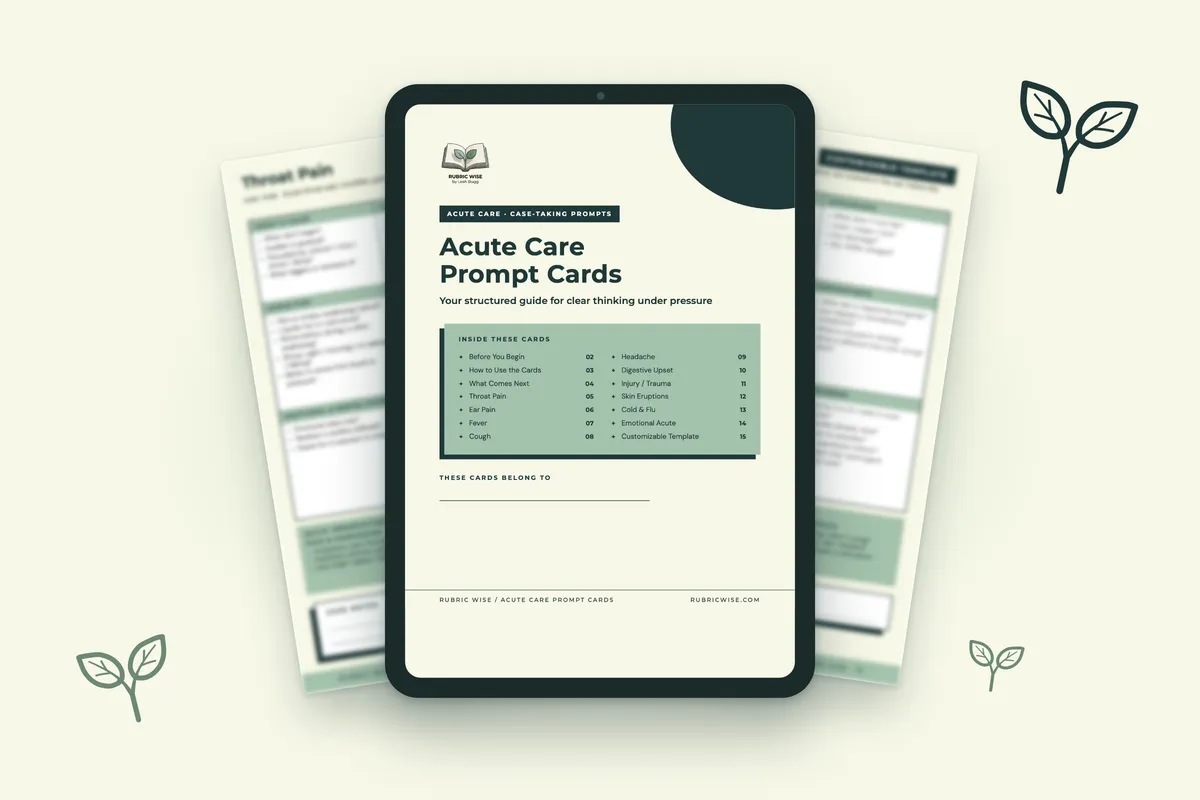
Conditions covered:

Why I made these
I was that student.
I was that student who was terrified to take my first case with my supervisor (and other students) watching. I had learned remedies but we saw a few clients in a row at the acute clinic and it moved fast. I felt like I would freeze and not know what to say.
What got me out of it wasn't learning more remedies. It was a process I built through repetition, a way of gathering a case that didn't depend on memory holding up under pressure. A simple prompt here and there in case I lost my way. Something I could easily adapt to the case, but didn't leave me fumbling for words. It helped me focus on where the client was taking me, knowing I had something to fall back on. It served me well over a year of taking acute cases via a helpline.
These cards are that structure, in your hands before your next fast-moving case, so you're not standing where I was.
Instant access
Get the prompt cards
Instant access, so you can begin using them today.
$19
PDF, ready to download and print straight after purchase
- 10 acute care prompt cards covering 10 main conditions
- A customizable, fillable template so that you can create your own prompts for conditions not covered here
Questions
Frequently asked questions
Do I need to be a homeopathy student to use these?
Not at all. These cards are designed for both students in training and home prescribers supporting their families. If you are gathering symptoms in an acute case, these cards will support you wherever you are in your learning.
Do I need repertory software to use these?
No. The cards support your acute case taking before you open any repertory tool, software or book. They work alongside resources such as Similia, RadarOpus, Kent's Repertory, or any repertory tool you use. For information on different repertory tools, please visit rubricwise.com/resources.
Can I use these for chronic cases?
These cards are designed specifically for acute case taking. Chronic prescribing requires a different depth of case taking that is not covered here.
What format are the cards delivered in?
A PDF file, ready to print or use on screen. You get instant access straight after purchase. Each card is one full page, designed to sit beside you during a case. You also receive a customizable, fillable template so you can create your own cards for conditions not covered here.
What if I am a complete beginner to homeopathy?
If you are brand new to homeopathy, start at the Welcome stage of the WISE Pathway. The Acute Cards assume a basic familiarity with homeopathic concepts like modalities and generals, though the cards are written in plain language and are accessible to motivated beginners.
Is this a replacement for supervision or professional training?
No. These cards are a learning tool to support acute case taking. They do not replace formal supervision, clinical training, or professional judgment. If you are a student, they complement your existing learning and help you think straight under pressure. They do not replace your formal training.
What if I don't use it?
Due to the nature of digital products, all sales are final, but if these don't make your next acute case calmer, email [email protected] within 14 days and I'll make it right.
Rubric Wise provides homeopathy education for informational purposes only. Content is not medical advice and is not a substitute for care from a licensed medical provider. Leah Bugg is a homeopath, not a medical doctor. These cards are a learning tool to support acute case taking. They do not replace formal supervision, clinical training, or professional judgment.